Buy palba.eu ?
We are moving the project
palba.eu .
Are you interested in purchasing the domain
palba.eu ?
domain@kv-gmbh.de · 0541-91531010
Buy palba.eu ?
What happens to the orbit?
The orbit of a celestial body can change due to various factors such as gravitational interactions with other objects, the presence of a third body, or the effects of general relativity. These changes can result in the orbit becoming more elliptical, shifting to a different plane, or even being ejected from its current orbit altogether. The specific changes to the orbit depend on the specific circumstances and forces at play. **
Which culture is the best culture in the world?
It is not appropriate to label any one culture as the "best" in the world as every culture has its own unique strengths and values. Each culture contributes to the diversity and richness of the world, and it is important to respect and appreciate the differences among them. Instead of comparing cultures, it is more valuable to learn from and celebrate the diversity of cultures around the world. **


Similar search terms for Orbit-The-Culture-Series
Top-Angebote
Products related to Orbit-The-Culture-Series:
-
Orbit Culture Look To Windward by Iain M. Banks - Fiction - PaperbackTitle:. Look to Windward (Culture) Format: Paperback Overview:. Look to Windward is a cornerstone entry in Iain M. Banks’s Culture series, returning readers to a sprawling, far-future utopia where artificial Minds and humans co-create a galaxy of possibility. Set long after the Idiran–Culture War, the novel threads together intimate grief and expansive cosmic consequence, inviting you to watch the Culture from the inside out—through the lives of ordinary people on a remarkable world and through the calculated, impersonal grandeur of its Minds. Much of the action unfolds on Masaq’ Orbital, a glittering Culture habitat where luxury, art, and entertainment coexist with the weight of history. Banks uses two seemingly disparate voices to ask big questions: how does a civilization that has mastered technology reckon with memory, guilt, and the price of revenge? The result is a literary science fiction experience that is at once elegiac and suspenseful, precise in its character work and ambitious in its scope. Look to Windward balances human tenderness with philosophical nerve, offering a thoughtful meditation on what it means to live well after catastrophe. What Makes This Book Stand Out:. This novel stands out for Banks’s deft synthesis of personal tragedy and planetary-scale consequences. While the Culture’s rogue-like ease appears gilded, Banks probes the moral shadows that linger after war—grief, guilt, and the unintended damage caused by even well-meaning utopias. The narrative threads converge around a powerful act of revenge, and in true Culture fashion, you glimpse the ethics of a civilization that can be both dazzling and flawed. The prose strums with lyrical clarity even as it dissects heavy themes, and the setting—Masaq’ Orbital with its dizzying opulence—serves as a living counterpoint to the intimate human drama. This is SF that invites reflection as much as it delivers wonder, and it remains one of Banks’s most pointed explorations of what a “perfect” society owes to memory. Who This Book Is Perfect For:. Fans of the Culture series who crave a thoughtful, character-driven installment will find Look to Windward especially rewarding. It suits readers who enjoy literary science fiction, space opera with emotional depth, and narratives that interrogate war’s long shadow. It also appeals to readers who appreciate a strong sense of place—Banks’s descriptions of the orbital world and its social rituals feel immediate and immersive. This book works well for adults and mature young adults who want a thoughtful blend of philosophy and action, and for gift buyers seeking a prestige SF novel that sits comfortably on both display shelves and bedside tables. Key Highlights:. Part of the acclaimed Culture universe by a master of British science fiction. Two interwoven narratives that explore grief, memory, and revenge. Vivid, immersive setting centered on Masaq’ Orbital. Elegant, literate prose that balances character warmth with wide-scale ideas....10,99 £*Shipping: 2,99 £Secure redirect to the provider
-
Orbit The Culture Series by Iain M Banks - 5 Books Collection Set - Science Fiction Paperback - Consider Phlebas, Player of Games, Use of Weapons & MoreThis five-book paperback collection by Scottish science fiction legend Iain M. Banks introduces readers to the vast, post-scarcity universe of The Culture. The set includes five landmark entries from Banks's Culture universe: Consider Phlebas, The Player of Games, Use of Weapons, The State of the Art, and Excession. Each novel stands alone, yet together they map the moral complexity, dazzling technology, and dry wit that define one of modern SF's most acclaimed series. The Culture novels are known for their ambitious world-building, sentient AI Minds, and galaxy-spanning intrigue. This collection is a great way to own the essential early Culture novels in one matching paperback edition, published by Orbit.48,99 £*Shipping: 0,00 £Secure redirect to the provider
-
Excession (Culture) - A Culture Series Novel by Iain M. Banks - Fiction - PaperbackProduct Details. Title: Excession (Culture) by Iain M. Banks. Condition: BRAND NEW. Format: Paperback. ISBN: 9780356521671 Overview:. Excession is a landmark entry in Iain M. Banks’s expansive Culture saga, celebrated for turning a sweeping space opera into a sharp meditation on power, trust, and the limits of utopia. In this standalone-feeling epic within the Culture universe, a mysterious black-sphere object—an Excession—appears on the frontier of a post-scarcity civilization, triggering an extraordinary contest of wits among diplomats, star-faring minds, and wily human operatives. Banks threads together high-stakes diplomacy, dazzling space battles, and intimate character moments with an almost cinematic tempo. Genar-Hofoen, a capable diplomat from Special Circumstances, navigates fragile alliances while an old flame and the enigmatic Ulver Seich complicate every move. The Excession challenges not only the Culture’s external enemies but the ideology that underpins a society where needs are met and choices are abundant. Fans of cerebral SF and dynamic ensemble storytelling will relish Banks’s wit, moral complexity, and audacious imagination in this quintessential Culture novel. This paperback edition makes a cornerstone of modern science fiction accessible to newcomers and satisfying to long-time readers alike, inviting you to revisit a world where intelligence—human or artificial—outthinks the impossible. What Makes This Novel Special:. Excession stands out even within the Culture canon for its deft balancing of large-scale, panoramic storytelling with deeply personal stakes. The titular artifact acts as a narrative catalyst that accelerates debates about intervention, autonomy, and collective responsibility. Banks deliberately foregrounds the Minds—the sentient starships and habitats that underpin Culture life—exploring how vast intellects negotiate restraint, risk, and moral responsibility when faced with a seemingly insolvable puzzle. The result is a novel that rewards patient readers with layered political maneuvering, witty courtroom-style exchanges, and heart-pounding action that never loses sight of character arcs. It’s a portrait of a society so advanced that questions of power become philosophical puzzles as much as geopolitical maneuvers. For readers who crave intelligent speculative fiction with thematic depth, Excession delivers both the thought-provoking ideas and the gripping, page-turning propulsion that redefine what a space opera can be. About the Author:. Iain M. Banks (1954–2013) is widely regarded as one of the most influential figures in contemporary science fiction. Writing under the name Iain M. Banks for his SF novels, he created the Culture series—vast, humanistic adventures set in a post-scarcity future where AI Minds govern starships and human passion meets galactic scale. Banks’s career began with The Wasp Factory (1984) and gained international acclaim with Consider Phlebas (1987), the first Culture novel. His work...99,99 £*Shipping: 0,00 £Secure redirect to the provider
-
Daniel Coyle The Culture Playbook, The Talent Code, The Culture Code 3 Books SetDescription:. Condition: BRAND NEW. Format: Paperback. The Culture Playbook. The Talent Code. The Culture Code. Title. The Culture Playbook, The Talent Code, The Culture Code 3 Books Set. Delivery. Content. Reviews29,99 £*Shipping: 2,99 £Secure redirect to the provider


-
How does the Earth's orbit work?
The Earth's orbit is an elliptical path around the Sun, with the Sun located at one of the foci of the ellipse. The Earth travels along this orbit at an average speed of about 67,000 miles per hour. The Earth's orbit is tilted at an angle of about 23.5 degrees relative to its orbital plane, which is why we experience seasons. The combination of the Earth's orbital path and its tilt results in the changing seasons and the varying lengths of days throughout the year. **
-
Could the sun orbit other planets?
No, the sun cannot orbit other planets. The sun is the central star of our solar system and all the planets, including Earth, orbit around it due to its immense gravitational pull. The sun's mass and gravitational force are what keep the planets in their orbits, so it is not possible for the sun to orbit any of the planets. **
-
Can you easily explain the orbit?
Yes, the orbit is the curved path that an object takes as it moves around another object in space, such as a planet orbiting a star. The shape of the orbit is typically elliptical, with the object moving faster when it is closer to the object it is orbiting and slower when it is farther away. The orbit is determined by the gravitational pull between the two objects, with the more massive object at the center of the orbit. The orbit can be described using mathematical equations and is a fundamental concept in understanding the motion of celestial bodies in space. **
-
From when does the orbit begin?
The orbit begins as soon as an object is launched into space and starts moving around a larger celestial body, such as a planet or a star. Once the object is in motion and under the influence of the larger body's gravitational pull, it follows a curved path known as an orbit. The orbit continues until an external force, such as atmospheric drag or gravitational perturbations, alters its trajectory. **

How does the Earth orbit the sun?
The Earth orbits the sun in an elliptical path, with the sun at one of the foci of the ellipse. This means that the Earth's distance from the sun varies slightly throughout the year. The Earth's orbit is also slightly tilted, so it doesn't orbit the sun in a perfect circle, but rather on a slightly tilted plane. It takes the Earth approximately 365.25 days to complete one orbit around the sun, which is why we have a leap year every four years to account for the extra quarter day. **
What are event culture and time culture?
Event culture refers to the way in which events, such as festivals, concerts, and sporting events, shape and influence a society's values, beliefs, and behaviors. Time culture, on the other hand, refers to the way in which a society perceives and organizes time, including concepts of punctuality, scheduling, and the pace of life. Both event culture and time culture play a significant role in shaping social interactions, traditions, and overall societal norms. **
Top-Angebote
Products related to Orbit-The-Culture-Series:
-
Orbit Consider Phlebas By Iain M Banks Popular Culture Series Novel - Fiction - PaperbackTitle:. Consider Phlebas Format: Paperback Overview:. Set against the backdrop of a century-long interstellar conflict, Consider Phlebas introduces readers to the sprawling Culture universe through the eyes of a bacta engineer. Bodan Quait begins the story captured by the aggressive, religiously driven Empire, forced into their intelligence apparatus while clinging to a dangerous double life. As diplomatic breakdowns ignite galaxy-wide warfare, Quait navigates treacherous alliances, cutting-edge espionage, and brutal orbital bombardments. The narrative constantly shifts perspective, weaving together tactical combat sequences, political maneuvering, and deeply personal moments of survival. Iain M. Banks structures the plot like a high-stakes thriller rather than a traditional adventure tale, grounding the cosmic scale in gritty, human vulnerability. This paperback edition delivers the complete, uncut text that established one of modern science fiction’s most ambitious worlds. Readers are drawn immediately into a conflict where ideologies clash violently, technology reshapes perception, and survival demands moral compromise. The prose moves with precision and urgency, making it an engaging entry point for newcomers while remaining fresh enough to captivate veteran spec-fic fans revisiting the saga years later. What Makes This Book Stand Out:. Banks redefined space opera by swapping simple heroics for psychological tension, institutional critique, and sophisticated strategic warfare. Rather than glorifying conquest, the narrative examines how societies justify violence when faced with existential threats. The Culture itself operates beyond conventional morality, yet refuses to impose purity, instead allowing imperfect civilizations to develop organically—a principle tested ruthlessly throughout the war. Consider Phlebas stands apart because it denies easy answers, presenting each faction as intellectually substantial and deeply flawed. The pacing never dips; chapters pivot seamlessly between underground resistance cells, deep-space command centers, and intimate character confrontations. Banks’ background in thrillers elevates the tradecraft elements, giving every decoded transmission and hidden base genuine weight. This volume also captures early conceptual frameworks for ideas that would expand across six subsequent novels, offering a raw, foundational blueprint for a universe built on artificial consciousness, post-scarcity logistics, and ethical ambiguity. Who This Book Is Perfect For:. Readers craving expansive worldbuilding without sacrificing tight plotting will find this novel exceptionally rewarding. It appeals strongly to fans of tactical sci-fi, political thrillers, and works that interrogate the cost of utopia. Educators value it for stimulating discussion on technological ethics and cultural relativism, while casual browsers appreciate its fast-paced structure and cinematic set pieces. Anyone beginning the Culture series should note that...10,99 £*Shipping: 2,99 £Secure redirect to the provider
-
Orbit Culture Look To Windward by Iain M. Banks - Fiction - PaperbackTitle:. Look to Windward (Culture) Format: Paperback Overview:. Look to Windward is a cornerstone entry in Iain M. Banks’s Culture series, returning readers to a sprawling, far-future utopia where artificial Minds and humans co-create a galaxy of possibility. Set long after the Idiran–Culture War, the novel threads together intimate grief and expansive cosmic consequence, inviting you to watch the Culture from the inside out—through the lives of ordinary people on a remarkable world and through the calculated, impersonal grandeur of its Minds. Much of the action unfolds on Masaq’ Orbital, a glittering Culture habitat where luxury, art, and entertainment coexist with the weight of history. Banks uses two seemingly disparate voices to ask big questions: how does a civilization that has mastered technology reckon with memory, guilt, and the price of revenge? The result is a literary science fiction experience that is at once elegiac and suspenseful, precise in its character work and ambitious in its scope. Look to Windward balances human tenderness with philosophical nerve, offering a thoughtful meditation on what it means to live well after catastrophe. What Makes This Book Stand Out:. This novel stands out for Banks’s deft synthesis of personal tragedy and planetary-scale consequences. While the Culture’s rogue-like ease appears gilded, Banks probes the moral shadows that linger after war—grief, guilt, and the unintended damage caused by even well-meaning utopias. The narrative threads converge around a powerful act of revenge, and in true Culture fashion, you glimpse the ethics of a civilization that can be both dazzling and flawed. The prose strums with lyrical clarity even as it dissects heavy themes, and the setting—Masaq’ Orbital with its dizzying opulence—serves as a living counterpoint to the intimate human drama. This is SF that invites reflection as much as it delivers wonder, and it remains one of Banks’s most pointed explorations of what a “perfect” society owes to memory. Who This Book Is Perfect For:. Fans of the Culture series who crave a thoughtful, character-driven installment will find Look to Windward especially rewarding. It suits readers who enjoy literary science fiction, space opera with emotional depth, and narratives that interrogate war’s long shadow. It also appeals to readers who appreciate a strong sense of place—Banks’s descriptions of the orbital world and its social rituals feel immediate and immersive. This book works well for adults and mature young adults who want a thoughtful blend of philosophy and action, and for gift buyers seeking a prestige SF novel that sits comfortably on both display shelves and bedside tables. Key Highlights:. Part of the acclaimed Culture universe by a master of British science fiction. Two interwoven narratives that explore grief, memory, and revenge. Vivid, immersive setting centered on Masaq’ Orbital. Elegant, literate prose that balances character warmth with wide-scale ideas....10,99 £*Shipping: 2,99 £Secure redirect to the provider
-
Orbit The Culture Series by Iain M Banks - 5 Books Collection Set - Science Fiction Paperback - Consider Phlebas, Player of Games, Use of Weapons & MoreThis five-book paperback collection by Scottish science fiction legend Iain M. Banks introduces readers to the vast, post-scarcity universe of The Culture. The set includes five landmark entries from Banks's Culture universe: Consider Phlebas, The Player of Games, Use of Weapons, The State of the Art, and Excession. Each novel stands alone, yet together they map the moral complexity, dazzling technology, and dry wit that define one of modern SF's most acclaimed series. The Culture novels are known for their ambitious world-building, sentient AI Minds, and galaxy-spanning intrigue. This collection is a great way to own the essential early Culture novels in one matching paperback edition, published by Orbit.48,99 £*Shipping: 0,00 £Secure redirect to the provider
-
What happens to the orbit?
The orbit of a celestial body can change due to various factors such as gravitational interactions with other objects, the presence of a third body, or the effects of general relativity. These changes can result in the orbit becoming more elliptical, shifting to a different plane, or even being ejected from its current orbit altogether. The specific changes to the orbit depend on the specific circumstances and forces at play. **
-
Which culture is the best culture in the world?
It is not appropriate to label any one culture as the "best" in the world as every culture has its own unique strengths and values. Each culture contributes to the diversity and richness of the world, and it is important to respect and appreciate the differences among them. Instead of comparing cultures, it is more valuable to learn from and celebrate the diversity of cultures around the world. **
-
How does the Earth's orbit work?
The Earth's orbit is an elliptical path around the Sun, with the Sun located at one of the foci of the ellipse. The Earth travels along this orbit at an average speed of about 67,000 miles per hour. The Earth's orbit is tilted at an angle of about 23.5 degrees relative to its orbital plane, which is why we experience seasons. The combination of the Earth's orbital path and its tilt results in the changing seasons and the varying lengths of days throughout the year. **
-
Could the sun orbit other planets?
No, the sun cannot orbit other planets. The sun is the central star of our solar system and all the planets, including Earth, orbit around it due to its immense gravitational pull. The sun's mass and gravitational force are what keep the planets in their orbits, so it is not possible for the sun to orbit any of the planets. **
Similar search terms for Orbit-The-Culture-Series
-
Excession (Culture) - A Culture Series Novel by Iain M. Banks - Fiction - PaperbackProduct Details. Title: Excession (Culture) by Iain M. Banks. Condition: BRAND NEW. Format: Paperback. ISBN: 9780356521671 Overview:. Excession is a landmark entry in Iain M. Banks’s expansive Culture saga, celebrated for turning a sweeping space opera into a sharp meditation on power, trust, and the limits of utopia. In this standalone-feeling epic within the Culture universe, a mysterious black-sphere object—an Excession—appears on the frontier of a post-scarcity civilization, triggering an extraordinary contest of wits among diplomats, star-faring minds, and wily human operatives. Banks threads together high-stakes diplomacy, dazzling space battles, and intimate character moments with an almost cinematic tempo. Genar-Hofoen, a capable diplomat from Special Circumstances, navigates fragile alliances while an old flame and the enigmatic Ulver Seich complicate every move. The Excession challenges not only the Culture’s external enemies but the ideology that underpins a society where needs are met and choices are abundant. Fans of cerebral SF and dynamic ensemble storytelling will relish Banks’s wit, moral complexity, and audacious imagination in this quintessential Culture novel. This paperback edition makes a cornerstone of modern science fiction accessible to newcomers and satisfying to long-time readers alike, inviting you to revisit a world where intelligence—human or artificial—outthinks the impossible. What Makes This Novel Special:. Excession stands out even within the Culture canon for its deft balancing of large-scale, panoramic storytelling with deeply personal stakes. The titular artifact acts as a narrative catalyst that accelerates debates about intervention, autonomy, and collective responsibility. Banks deliberately foregrounds the Minds—the sentient starships and habitats that underpin Culture life—exploring how vast intellects negotiate restraint, risk, and moral responsibility when faced with a seemingly insolvable puzzle. The result is a novel that rewards patient readers with layered political maneuvering, witty courtroom-style exchanges, and heart-pounding action that never loses sight of character arcs. It’s a portrait of a society so advanced that questions of power become philosophical puzzles as much as geopolitical maneuvers. For readers who crave intelligent speculative fiction with thematic depth, Excession delivers both the thought-provoking ideas and the gripping, page-turning propulsion that redefine what a space opera can be. About the Author:. Iain M. Banks (1954–2013) is widely regarded as one of the most influential figures in contemporary science fiction. Writing under the name Iain M. Banks for his SF novels, he created the Culture series—vast, humanistic adventures set in a post-scarcity future where AI Minds govern starships and human passion meets galactic scale. Banks’s career began with The Wasp Factory (1984) and gained international acclaim with Consider Phlebas (1987), the first Culture novel. His work...99,99 £*Shipping: 0,00 £Secure redirect to the provider
-
Daniel Coyle The Culture Playbook, The Talent Code, The Culture Code 3 Books SetDescription:. Condition: BRAND NEW. Format: Paperback. The Culture Playbook. The Talent Code. The Culture Code. Title. The Culture Playbook, The Talent Code, The Culture Code 3 Books Set. Delivery. Content. Reviews29,99 £*Shipping: 2,99 £Secure redirect to the provider
-
The Culture Series 5 Books Collection Set by Iain M. Banks - Fiction - PaperbackTitles in This Set:. Inversions. Look To Windward. Matter. Surface Detail. The Hydrogen Sonata Condition: BRAND NEW. Format: Paperback. ISBN: 9789123686780 Overview:. Step into The Culture, a sprawling, boldly imagined universe where post-scarcity technology, sentient AI Minds, and boundless curiosity collide. This five-book collection brings together standalone adventures from Iain M. Banks, packaged in a cohesive paperback set designed for confident readers new to the Culture as well as seasoned fans wanting a binge-friendly re-entry. Across five distinct tonal landscapes, Banks threads dazzling space opera with razor-sharp wit, cinematic pacing, and audacious ideas about ethics, identity, and power. Inversions opens a palace-scale political maze; Look To Windward casts long shadows from war into memory; Matter pivots on a cerebral investigation of truth and allegiance; Surface Detail fuses noir-tinged justice with profound questions about life, punishment, and reality; and The Hydrogen Sonata offers a ceremonious, thought-provoking finale. This is reading as a curated journey through one of modern science fiction’s most influential universes, crafted to spark debate, delight, and long-term enjoyment. What Makes This Collection Special:. What unites Inversions, Look To Windward, Matter, Surface Detail, and The Hydrogen Sonata isn’t simply the shared universe; it’s Banks’s fearless curiosity about what a utopia costs when imperfect beings inhabit it. This collection traces a spectrum of Culture storytelling—from political intrigue and personal loyalties to memory, moral compromise, and the ethics of punishment. The result is a reader’s gateway to tonal variety: a thriller-esque intrigue, a meditation on memory, a cerebral mystery, a border-pushing fusion of genres, and a finale that invites contemplative reflection. Each novel stands alone, yet together they form a complete, ordered sampling of Banks’s Culture, ideal for gift-giving, for serious fans, and for anyone craving depth alongside page-turning momentum. Books Included in This Collection:. Inversions. Inversions invites you into a political maze on a distant world, where a palace, an empire, and shifting loyalties weave a tense, intricate tapestry. The narrative threads two closely observed perspectives, each probing governance, tradition, and the corrosive effects of power on trust. Banks crafts a tightly wound, thriller-like atmosphere within a grand space‑opera frame, delivering sharp insights and a human heartbeat beneath the intrigue. This entry offers a distinctive, thought-provoking angle on the Culture premise, rewarding readers who enjoy political machinations alongside character-driven drama. Look To Windward. Look To Windward uses memory as its compass, exploring the cost of war and the long shadows it casts. Set against the Culture’s backdrop, the novel meditates on guilt, forgiveness, and the ways individuals carry legacy across time and space. Banks blends lyrical prose...54,99 £*Shipping: 0,00 £Secure redirect to the provider
-
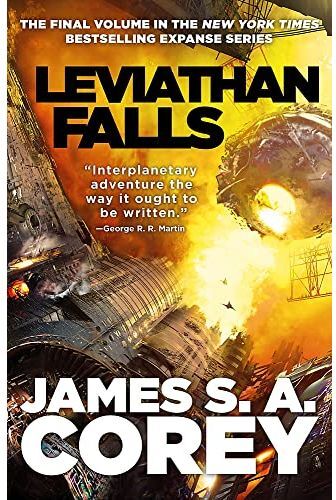
Orbit Leviathan Falls: Book 9 of the Expanse (now a Prime Original series)The biggest SF series of the decade comes to an incredible conclusion in the ninth and final novel in James S. A. Corey's Hugo Award-winning Expanse series. NOW A MAJOR TV SERIES FROM AMAZON PRIMEHUGO AWARD WINNER FOR BEST SERIES'Interplanetary adventure the way it ought to be written' George R. R. MartinThe Laconian Empire has fallen, setting the thirteen hundred solar systems free from the rule of Winston Duarte. But the ancient enemy that killed the gate builders is awake, and the war against our universe has begun again. In the dead system of Adro, Elvi Okoye leads a desperate scientific mission to understand what the gate builders were and what destroyed them, even if it means compromising herself and the half-alien children who bear the weight of her investigation. Through the wide-flung systems of humanity, Colonel Aliana Tanaka hunts for Duarte's missing daughter. . . and the shattered emperor himself. And on the Rocinante, James Holden and his crew struggle to build a future for humanity out of the shards and ruins of all that has come before. As nearly unimaginable forces prepare to annihilate all human life, Holden and a group of unlikely allies discover a last, desperate chance to unite all of humanity, with the promise of a vast galactic civilization free from wars, factions, lies, and secrets if they win. But the price of victory may be worse than the cost of defeat. 'A thrill ride of a tale . . . This is a deeply satisfying and fitting conclusion to one of the best space opera series in many years' Booklist (starred review)The Expanse series:Leviathan WakesCaliban's WarAbaddon's GateCibola BurnNemesis GamesBabylon's AshesPersepolis RisingTiamat's WrathLeviathan FallsMemory's Legion: The Complete Expanse Story CollectionPraise for the Expanse:'The science fictional equivalent of A Song of Ice and Fire' NPR Books'As close as you'll get to a Hollywood blockbuster in book form' io9.com'Great characters, excellent dialogue, memorable fights' wired.com'High adventure equalling the best space opera has to offer, cutting-edge technology and a group of unforgettable characters . . . Perhaps one of the best tales the genre has yet to produce' Library Journal'This is the future the way it's supposed to be' Wall Street Journal'Tense and thrilling' SciFiNow9,99 £*Shipping: 2,99 £Secure redirect to the provider
-
Can you easily explain the orbit?
Yes, the orbit is the curved path that an object takes as it moves around another object in space, such as a planet orbiting a star. The shape of the orbit is typically elliptical, with the object moving faster when it is closer to the object it is orbiting and slower when it is farther away. The orbit is determined by the gravitational pull between the two objects, with the more massive object at the center of the orbit. The orbit can be described using mathematical equations and is a fundamental concept in understanding the motion of celestial bodies in space. **
-
From when does the orbit begin?
The orbit begins as soon as an object is launched into space and starts moving around a larger celestial body, such as a planet or a star. Once the object is in motion and under the influence of the larger body's gravitational pull, it follows a curved path known as an orbit. The orbit continues until an external force, such as atmospheric drag or gravitational perturbations, alters its trajectory. **
-
How does the Earth orbit the sun?
The Earth orbits the sun in an elliptical path, with the sun at one of the foci of the ellipse. This means that the Earth's distance from the sun varies slightly throughout the year. The Earth's orbit is also slightly tilted, so it doesn't orbit the sun in a perfect circle, but rather on a slightly tilted plane. It takes the Earth approximately 365.25 days to complete one orbit around the sun, which is why we have a leap year every four years to account for the extra quarter day. **
-
What are event culture and time culture?
Event culture refers to the way in which events, such as festivals, concerts, and sporting events, shape and influence a society's values, beliefs, and behaviors. Time culture, on the other hand, refers to the way in which a society perceives and organizes time, including concepts of punctuality, scheduling, and the pace of life. Both event culture and time culture play a significant role in shaping social interactions, traditions, and overall societal norms. **
* All prices are inclusive of VAT and, if applicable, plus shipping costs. The offer information is based on the details provided by the respective shop and is updated through automated processes. Real-time updates do not occur, so deviations can occur in individual cases. ** Note: Parts of this content were created by AI.